
Design for the Ocean
What does it take for people to care about a place most of them will never see? Design for the Ocean explores how communication design can move people across the dimensions of ocean literacy: from knowing about the ocean, to feeling connected to it, to acting for it.
Institution
School of Design, University of Leeds
Period
2021 – present
Design research
Communication design, ocean literacy, game-based learning, visual exploration
Status
Ongoing
The project
Design for the Ocean is a project brief for MA Design students at the University of Leeds School of Design.
Since 2021, students have taken on the brief to research, design and evaluate solutions that strengthen people’s relationship with the ocean, from board games and animations to interactive websites and printed infographics. Each project targets one or more dimensions of ocean literacy and is tested with real participants.
Why the ocean?
The ocean covers 71% of the planet’s surface and holds 97% of its water. It gives us food, medicines and energy, and it plays a central role in regulating Earth’s climate.
According to the IPCC’s Sixth Assessment Report, human activities, mainly through greenhouse gas emissions, have unequivocally caused global warming. Those emissions keep rising, and responsibility is unequal: between regions, between and within countries, and between individuals. Extreme weather is becoming more frequent, the global water cycle is shifting, and the ocean is changing at an unprecedented rate.
Yet across many countries, people show limited understanding of ocean issues. That gap has been linked to low concern and low engagement. It’s hard to protect what you don’t understand, and harder still to care about what you never think about.
What’s at stake
Warming, as the ocean absorbs heat from a warming planet.
Acidification, as seawater absorbs carbon dioxide and becomes more acidic.
Sea level rise and coastal erosion, reshaping coastlines and the communities that live on them.
Eutrophication, when nutrient run-off fuels algal blooms that starve the water of oxygen.
Pollution, from plastics and ghost nets to underwater noise.
Biodiversity loss, the decline in species diversity and the risk of extinction underneath it all.

Ten dimensions of ocean literacy
Ocean literacy began in the early 2000s with a simple idea: understanding the ocean’s influence on you, and your influence on the ocean.
It was built on seven essential principles and designed for classrooms, on the assumption that more knowledge would lead to better behaviour. That assumption hasn’t held: only a small fraction of pro-environmental behaviour links directly to knowledge (Kollmuss and Agyeman, 2002).
So the concept evolved. Brennan et al. (2019) proposed six dimensions: knowledge, awareness, attitude, communication, behaviour and activism. McKinley, Burdon and Shellock (2023) added four more: emotional connection, access and experience, adaptive capacity, and trust and transparency. The UN Decade of Ocean Science for Sustainable Development (2021–2030) now places ocean literacy at the centre of changing society’s relationship with the ocean.
Ten dimensions, and one design question for each: what would it take to move people along this one?

Knowledge &
awareness
Knowledge sits at the heart of ocean literacy and is its most studied dimension. It is often treated as the precondition for change, yet only a small fraction of pro-environmental behaviour can be linked to it directly.
Awareness is knowing that a problem exists, and seeing both the threats and the options available. It has cognitive and emotional sides.
In The Blue Bounty study, an augmented reality board game improved knowledge and awareness significantly more than a traditional lecture. After playing, knowledge was positively linked with every other dimension, which suggests it may work as a gateway rather than an end point (Leitão, Yao and Guimarães, 2025).
Communication
How often do you talk about the ocean with family or friends? Communication covers that, and more: where people get their ocean information, which channels work best, and how organisations speak to different audiences (McKinley et al., 2023).
For communication designers, this is home ground. In The Blue Bounty study, awareness and communication rose together: players who became more aware also reported talking more about the ocean.
Emotional connection
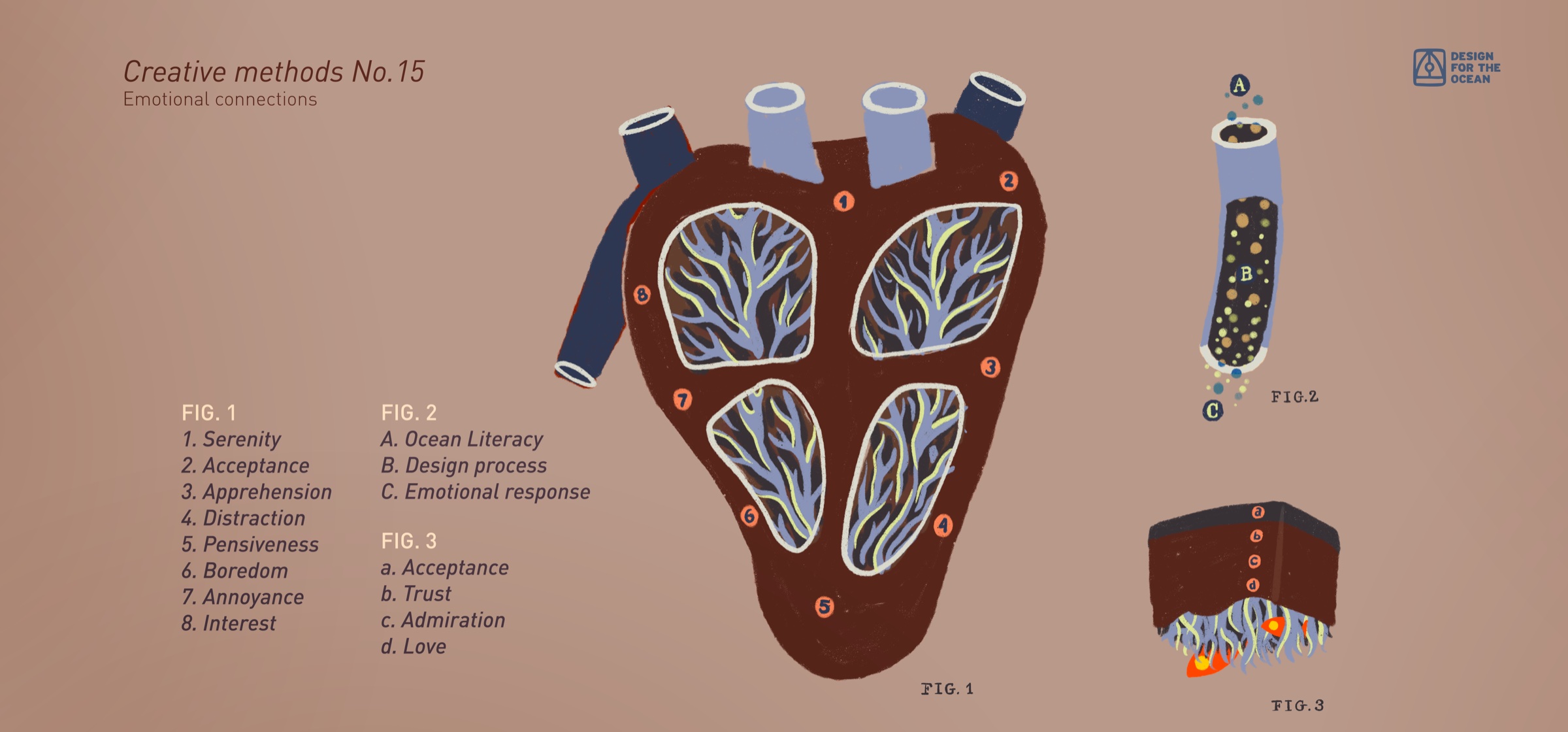
How do you feel when you think about the ocean, stand beside it, or read about what is happening to it? Wonder, calm, grief, anxiety: positive, negative or neutral, all are valid responses, and all can contribute to change (McKinley et al., 2023).
Emotional connection has received little research attention so far, which makes it fertile ground for design. The visual explorations below are my own attempts to work with it.
Attitude
Attitudes are the evaluations we hold of issues, of others and of ourselves: agreement, concern, values, interests and motivations. They grow out of what we think, feel and do, and they shape all three in return.
Understanding how society perceives the ocean is critical for designing interventions that support its conservation.
Behaviour
Behaviour is about decisions, choices and habits: what we buy, use and throw away. Much of the damage to the ocean comes from our collective, automated lifestyle choices.
Change happens only when people have the capability, the opportunity and the motivation to choose differently. Most studies, ours included, measure intended behaviour, which is a promise rather than proof.

Activism
Activism is the step from private choice to public action: campaigning online, joining rallies, writing to elected representatives. It turns concern into pressure for change in policy, attitudes and behaviour.
It also carries real risk. “Protecting the environment through protest has become an increasingly dangerous endeavour with harassment, persecution and death of activists occurring at the hands of both states and corporations” (Hasler et al., 2020, p. 517).
Beyond the individual
Three more dimensions pull ocean literacy beyond the individual (McKinley et al., 2023).
Access and experience: the real or virtual encounters people have with the ocean, and the barriers, such as the cost of travel, that keep many away from it.
Adaptive capacity: the ability of people and communities to adapt to a changing ocean, from climate impacts to shifting ocean economies.
Trust and transparency: how much people trust their sources of ocean information, and how open those sources and processes seem.
How design teaches
Why would a game, an animation or an infographic change how someone sees the ocean? Six ideas about learning keep coming up in ocean literacy projects, and they apply to any design solution.
Constructivism: we build knowledge by acting on the world, not by receiving it. Interactive pieces, from games to explorable websites, let people decide, test assumptions and read the consequences, gradually building mental models of complex marine systems. Start with Biggs (1996) and Vygotsky (1978).
Experiential learning: learning as a cycle of concrete experience, reflection, abstract thinking and active experimentation. Simulations, installations, AR and VR let people live through an environmental problem, reflect on it and try again. Start with Kolb (2014).
Social and collaborative learning: we learn by observing, talking and solving problems together. Ocean issues are social and political, so designs that get people discussing, sharing or co-creating show them that solutions are collective. See Bandura (1969) and Lave (1996).
Situated and place-based learning: knowledge means most in the context where it will be used. Linking a design to a museum, a local coast or a real community turns a distant global issue into something close and personal. See Billett (1996) and, on psychological distance, Loy and Spence (2020).
From knowledge to action: knowing more doesn’t automatically lead to acting better. Behaviour also depends on emotions, values, social influence and perceived efficacy, so a good design speaks to more than the head. See Kollmuss and Agyeman (2002) and Hungerford and Volk (1990).
Motivation and flow: we are intrinsically motivated when we feel autonomy, competence and relatedness, and absorbed when challenge matches skill. Useful for any experience that asks for people’s time and attention. See Ryan and Deci (2000), Csikszentmihalyi (1990), Malone (1981) and Dickey (2005).

Which strategy for which dimension?
No medium teaches by itself. What people take away depends on the design strategies behind it.
Most of the evidence so far comes from game-based projects, where these strategies are easiest to isolate (the MDA framework, Hunicke et al., 2004, and the Elemental Tetrad of mechanics, story, aesthetics and technology from Jesse Schell’s The Art of Game Design: A Book of Lenses, Schell, 2008, are useful lenses). But the strategies themselves apply to print, motion, web, installations and beyond:
Questions and instant feedback: knowledge and recall, mostly in the short term. Quizzes in games, but also interactive infographics or exhibits that respond to the viewer.
Taking on a role or perspective: attitudes, empathy and systems thinking, by seeing trade-offs through other eyes: a species, a fisher, a policymaker.
Choices with consequences: behavioural intentions, responsibility and critical thinking. Scenarios, branching stories and data visualisations that show “what if”.
Collaboration and dialogue: communication and collective problem-solving. Workshops, co-design sessions and shared experiences.
Storytelling: awareness, emotional engagement and personal relevance. Animation, illustrated narratives, documentary.
Exploration: curiosity, ocean connectedness and attachment to place. Explorable websites, AR, museum trails.
Treat these as emerging patterns, not rules: outcomes also depend on who the audience is, and where they meet the design.
How do you know it works?
Designing the solution is half the job. The other half is finding out what it actually changed.
These methods apply whether you designed a game, a poster series, an animation or a website.
Experimental and quasi-experimental designs: measure before and after people engage with your design, ideally against a comparison group, for example your design versus a standard leaflet or lecture.
Mixed methods: combine questionnaires with interviews, observation and focus groups to capture both what changed and what the experience felt like (Creswell, 2014).
Qualitative and case studies: observation, workshop notes and reflective feedback show how people engage and make sense of your design.
Participatory design and design-based research: bring your audience in as co-designers and refine the solution through repeated cycles of design, testing and revision.
What to measure: cognitive (knowledge tests), psychological (awareness, attitudes, motivation, emotional connection), behavioural (intentions, self-reported actions) and social (communication, collaboration) outcomes. Pick the ocean literacy dimensions your design targets.
Common pitfalls: small convenience samples, self-reported behaviour and testing only straight after the experience. If you can, use validated scales, a comparison group, direct observation of behaviour, and a follow-up weeks later.

Student work
What happens when designers take on these dimensions?
Since 2021, MA Design students at Leeds have worked with the Design for the Ocean theme, a brief run in collaboration with CIIMAR, the Interdisciplinary Centre of Marine and Environmental Research at the University of Porto, designing and testing their own ocean literacy tools. A few outputs:
Ice Age: Tracing the Origins
Players take on ecological roles in a prehistoric ocean, steering through icebergs and extreme environmental events. In playtests, university students’ ocean knowledge improved significantly.
Article under review

The Blue Bounty
An augmented reality board game in which players take on roles in a marine ecosystem. Tested against a traditional lecture, it improved knowledge and awareness significantly more.
Read the article · Image: Leitão et al. (2025), CC BY 4.0

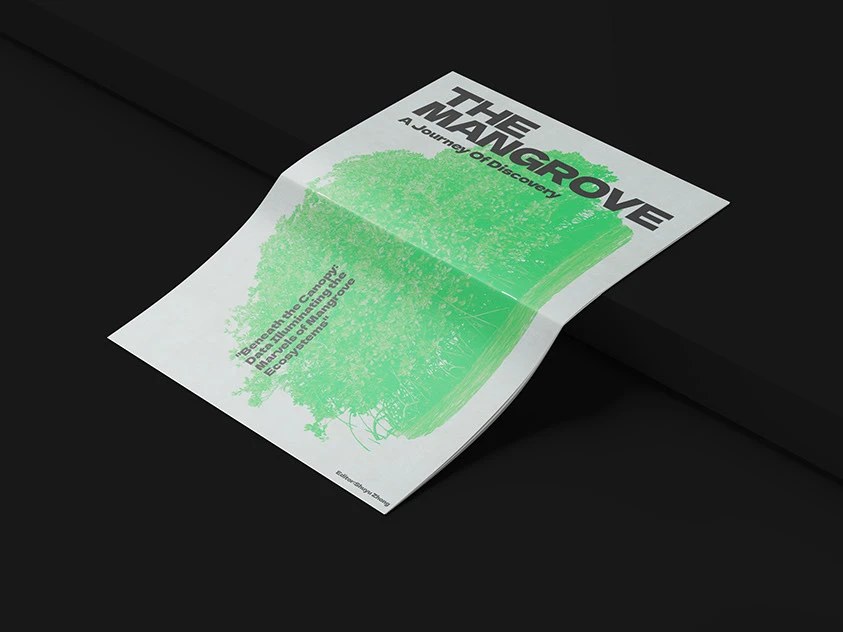
The Mangrove
A Journey of Discovery: an illustrated publication that takes readers into the mangrove, what it is, how it stores carbon, and why it is disappearing.
Publications
Leitão, R., Yao, S. and Guimarães, L. (2025). An augmented reality board game to work ocean literacy dimensions. Education and Information Technologies, 30, 19245–19268. https://doi.org/10.1007/s10639-025-13519-3
Leitão, R., Yao, S., Wu, Y. and Guimarães, L. (under review). Board game-based learning experience for ocean literacy: A design-based research study.
Explore further
Ocean Literacy: the 7 principles – UNESCO
The Ocean Decade 2021–2030 – United Nations
International Council for the Exploration of the Sea (ICES)
NOAA National Ocean Service – US National Oceanic and Atmospheric Administration
The Deep – aquarium and marine conservation charity, Hull
Ocean with David Attenborough – documentary
Our Oceans – documentary series
References
Bandura, A. (1969). Social-learning theory of identificatory processes. In D. A. Goslin (Ed.), Handbook of Socialization Theory and Research (pp. 213–262). Chicago: Rand McNally.
Creswell, J. W. (2014). Research Design: Qualitative, Quantitative and Mixed Methods Approaches. Thousand Oaks: Sage.
Csikszentmihalyi, M. (1990). Flow: The Psychology of Optimal Experience. New York: Harper & Row.
Hunicke, R., LeBlanc, M. and Zubek, R. (2004). MDA: A formal approach to game design and game research. Proceedings of the AAAI Workshop on Challenges in Game AI.
Kolb, D. A. (2014). Experiential Learning: Experience as the Source of Learning and Development (2nd ed.). Upper Saddle River: FT Press.
Malone, T. W. (1982). Heuristics for designing enjoyable user interfaces: Lessons from computer games. In Proceedings of the 1982 Conference on Human Factors in Computing Systems, 63–68.
Schell, J. (2008). The Art of Game Design: A Book of Lenses. Burlington, MA: Morgan Kaufmann.
Vygotsky, L. S. (1978). Mind in Society: The Development of Higher Psychological Processes. Cambridge, MA: Harvard University Press.